Polyhydroxyalkanoates (PHAs) are among the most promising biodegradable alternatives to fossil-based plastics. They are produced naturally by bacteria, biodegrade in soil and marine environments, and can be tailored for uses ranging from packaging to biomedical materials. Their market uptake is still held back by high production costs, most of which come from feedstocks and downstream processing.
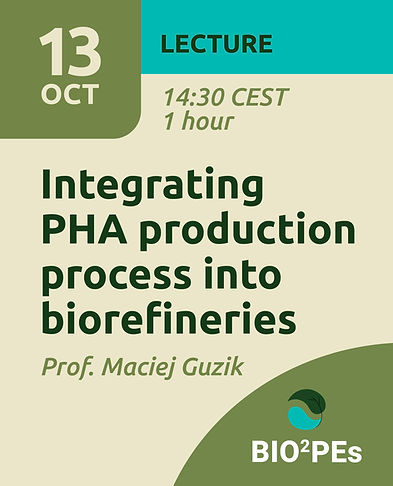
In this webinar, Prof. Guzik will explain how integrating PHA production into biorefinery value chains can help close that cost gap. He will discuss how residues and side streams can serve as low-cost carbon sources for bacterial PHA synthesis, including waste oils, crude glycerol, and post-consumer plastics. He will then cover the fermentation and downstream processing choices that determine yield, polymer quality, and economic viability. Finally, he will show how PHA production can sit alongside other biorefinery outputs instead of competing with them. The session links bioprocess research with the practical challenges of scale-up and market deployment.
The webinar is aimed at researchers, bioprocess engineers, industry professionals, and policymakers working in the circular bioeconomy and on next-generation bioplastics. A live Q&A will follow the presentation.
Maciej Guzik is a Professor of Biotechnology at the Jerzy Haber Institute of Catalysis and Surface Chemistry, Polish Academy of Sciences (IKiFP PAN) in Kraków, Poland. He received his PhD in Industrial Microbiology from University College Dublin in 2012, working on high-cell-density fermentation and the conversion of post-consumer polyethylene into biodegradable polyhydroxyalkanoates (PHAs). After several years at the UCD spin-out Bioplastech, he joined IKiFP PAN in 2015, habilitated in Chemistry in 2021 and in 2025 received a Full Professor title. His research focuses on bacterial PHAs — their production by fermentation, downstream processing, functionalization with bioactive molecules, and applications across the circular bioeconomy and biomedicine.