
Bacteria can make plastic > The real challenge is making it affordable. 🌱
Polyhydroxyalkanoates (PHAs) are among the most promising biodegradable alternatives to fossil-based plastics. They are produced naturally by bacteria, biodegrade in soil and marine environments, and can be tailored for uses ranging from packaging to biomedical materials.
So why aren't they everywhere yet? Production costs are still high, and most of that cost comes from two places: the feedstocks the bacteria are fed, and the downstream processing needed to recover the polymer.
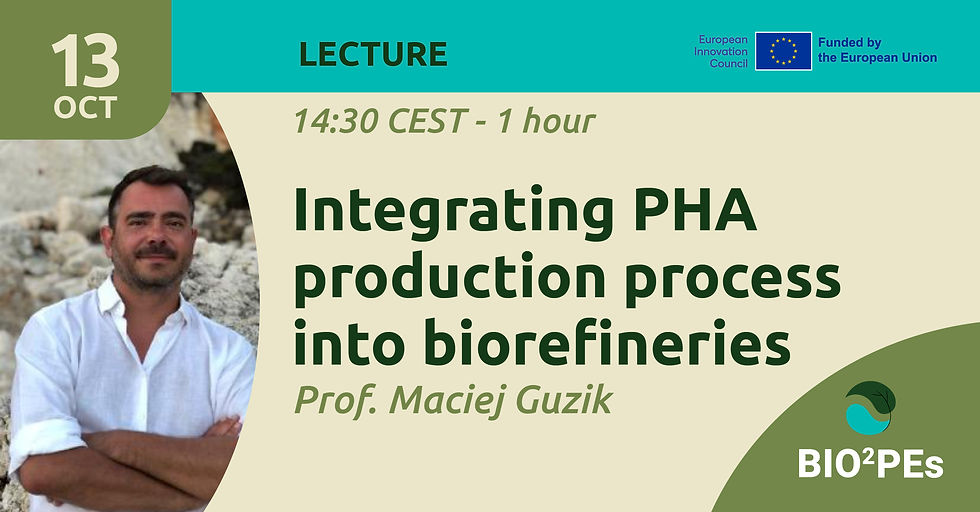
On 13 October, the Bio2PEs lecture "Integrating PHA production process into biorefineries" explores one of the most promising ways to close that gap: building PHA production directly into biorefinery value chains.
The session will walk through:
🔹 Feedstocks: how residues and side streams such as waste oils, crude glycerol and post-consumer plastics can become low-cost carbon sources for bacterial PHA synthesis.
🔹 Process design: the fermentation and downstream processing choices that determine yield, polymer quality and economic viability.
🔹 Integration: how PHA production can sit alongside other biorefinery outputs instead of competing with them.
The lecture bridges bioprocess research and the practical challenges of scale-up and market deployment, and ends with a live Q&A.
📅 13 October 2026
🕝 14:30 CEST | 1 hour
💻 Online
🎙️ Lecturer: Prof. Maciej Guzik, Jerzy Haber Institute of Catalysis and Surface Chemistry, Polish Academy of Sciences
🎤 Hosted by: Dr. Yuanyuan Chen, Technological University of the Shannon (TUS)
👥 For researchers, bioprocess engineers, industry professionals and policymakers working on the circular bioeconomy and next-generation bioplastics.
👉 Register now: https://lnkd.in/eUe7qqMD
hashtag#Bio2PEs hashtag#PHA hashtag#Bioplastics hashtag#Biorefinery hashtag#CircularBioeconomy hashtag#Bioeconomy hashtag#HorizonEurope hashtag#Bioprocessing


Comments